I recently listened to a sharing session by Yan Junjie, the founder of MiniMax, where he mentioned an extremely sharp insight: Past models fought their battles alone, but now, vision, language, and decision-making are moving toward a unified multi-modal future.
This view struck me like lightning.
As a Product Manager who has struggled in the e-commerce and data fields for years, I was once deeply anxious. In today’s world where Generative AI is sweeping through everything, is my formerly proud identity as a “Data Scientist”—the role that mined patterns, built predictive models, and drove decision intelligence—being marginalized? Are we about to be replaced by people who just know how to write Prompts?
But as I thought deeper, I realized: The disappearance of these boundaries does not mean the extinction of the Data Scientist, but an unprecedented “expansion of function.”
Generation is Decision. Once you understand this layer, you will realize that we are ushering in the golden age of Data Science.
I. Cognitive Reframing: Generation is Decision
For a long time, we have artificially divided AI into two worlds:
- Discriminative AI: Responsible for “Left-Brain Decisions.” For example, predicting whether a stock will rise or if a transaction is fraudulent. It is rational, but often a black box.
- Generative AI: Responsible for “Right-Brain Creation.” For example, writing a poem or painting a picture. It is emotional and seemingly unrelated to rigorous business decisions.
But the Scaling Law tells us that these two worlds are merging.
From the microscopic perspective of an LLM (Large Language Model), the generation of every single Token is essentially a micro-decision based on a full probability distribution. When a model “generates” a complex Chain of Thought to answer a question, it is actually deducing the optimal solution by Simulating multiple possibilities.
Generation is a sandbox simulation in the cognitive space.
Previously, our decisions were based on linear extrapolation of historical data (Fitting); now, decisions are based on the simulated generation of the future (Reasoning). This means that generation itself is the highest form of decision-making.
II. Ending the Pain Point: Reclaiming the Lost “Right to Act”
Understanding “Generation is Decision” unties the knot that has plagued data products for years—the Action Gap.
Looking back at the CRM systems or BI dashboards I developed in the past, our proud “Data-Driven” approach was often an Open Loop:
❌ The Old Model (Open Loop):
- Data (Input): The system detects user churn.
- Decision (Analysis): The algorithm analyzes the cause as “lack of targeted content outreach.”
- The Gap: The system can only pop up a window for the operations staff: “Please write a copy to win back the user.”
- Result: Did they write it? Was it good? The system has no right to interfere and no way to know.
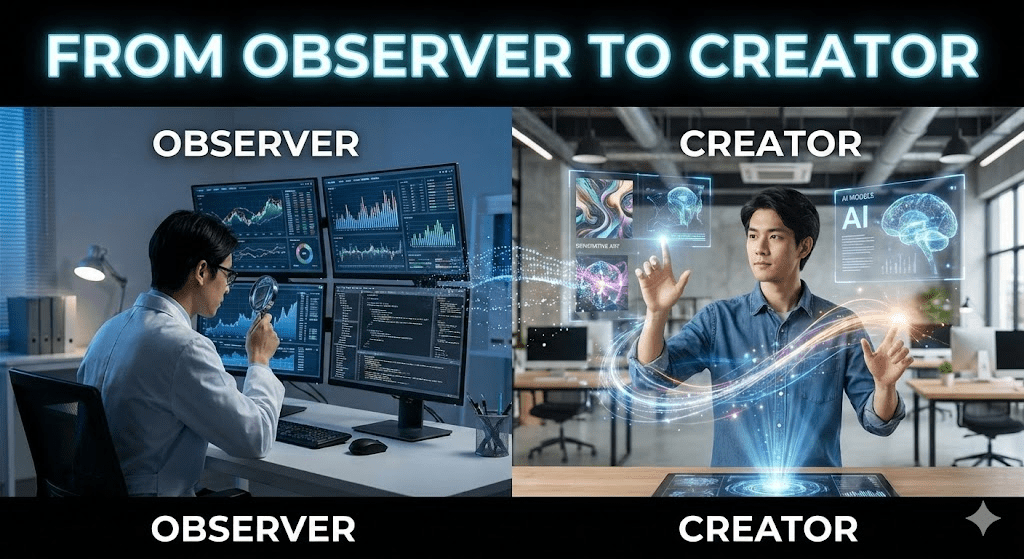
Data Scientists were once “Strategists without hands.” We possessed the strongest brains but could not directly control the limbs.
The emergence of AIGC fills in the missing piece of this loop. Current systems can now be Closed Loop:
✅ The New Model (Closed Loop):
- Data: Detects user churn.
- Decision: Determines that a video emphasizing “cost-effectiveness” is needed.
- Action (AIGC): The system directly calls the video generation model, produces the video, and automatically distributes it.
- Feedback: Monitors the video click-through rate. If low, it automatically optimizes the Prompt and regenerates.
AIGC turns “Action” into a capability that can be invoked by code (Action as API). Data Scientists are no longer just “observers” throwing results at humans, but “operators” commanding GPUs to execute tasks.
III. Paradigm Upgrade: From AIGC Tools to “Self-Healing Engines”
I am currently building an AIGC video tool. At first, I worried this was deviating from my “Data/Decision” roots, feeling like I was making a purely artistic tool.
But now I understand, I am not making a “paintbrush”; I am building a “Data-Based Video Optimization Engine.”
My core competitiveness lies not in how exquisite the video visuals are (that’s the job of the underlying model), but in injecting the logic of data decision-making into the video generation process:
- Diagnosis: When the video completion rate drops off a cliff at the 3rd second, my system identifies that the “Hook is too weak.”
- Prescription: The system automatically modifies the Prompt, cuts the sluggish intro, and inserts visually high-impact scenes.
- Self-Healing: Regenerate, re-distribute, until the data improves.
This is exactly what physicist Richard Feynman meant: “What I cannot create, I do not understand.”
By building an agent capable of “self-correction,” we are actually using engineering means to approach the essence of intelligence.
Conclusion: Data Scientist Version 2.0
The AI era has not killed the Data Scientist; it just demands that we evolve.
- Data Scientist 1.0: We needed to know Statistics and SQL, with the goal of Explaining the Past.
- Data Scientist 2.0: We need to know Prompt Engineering, Agent Architecture, and Reward Design, with the goal of Planning the Future through Generation.
In this new era, we are no longer just analysts analyzing data; we are architects of intelligent systems. We solidify decision logic into code, express it through AIGC, and form a closed loop using data feedback.
This is not a deviation from our path; rather, it is a dimensionality-reduction style reuse of all our past experiences.
Colleagues, don’t just be the person who watches the data. Go try being the person who “creates.”
 Way to data scientist
Leave a comment