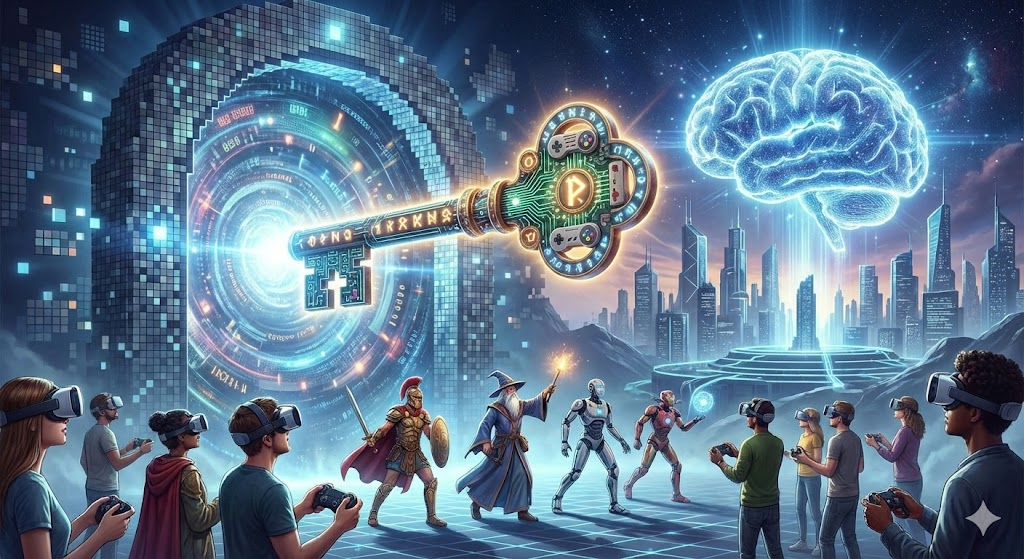
If someone told you that the ultimate key to human Superintelligence lies not in cold laboratory codebases, but within that worn-out game controller in your hand, what would you think?
Recently, reflecting on key milestones in AI development, I’ve come to realize that games have played a massive role—perhaps even serving as one of the optimal paths toward AGI. This realization has corrected many of my long-held prejudices against gaming.
This feeling intensified after watching DeepMind’s documentary, The Thinking Game. The film showcases how they used games to “feed” AI—from clumsily playing retro Atari games to AlphaGo defeating humanity with otherworldly intuition on the Go board, and finally demonstrating dominance in StarCraft, a real-time strategy game with infinite possibilities.
This brings to mind Elon Musk’s terrifying yet fascinating hypothesis: that humanity might be living in a simulation constructed by a higher civilization. Pulling our perspective back to reality, we find a startling coincidence: Tesla’s autopilot system spends most of its time training in a virtual “driving simulator”; Feifei Li’s Marble world model and DeepMind’s latest Genie 3 are, in essence, building interactive virtual space-times.
Pieced together, these fragments point to an underestimated truth: Games are not just vehicles for entertainment; they are the starting point for AI and the crucial proving ground for training superintelligence.
I. The Accidental “Conspiracy” of Compute and Wisdom
Looking back at history, the relationship between AI and the gaming industry hasn’t been a one-way street of exploitation, but rather a “conspiracy” spanning decades.
We often marvel at the computational foundation of today’s large models, yet we often overlook who laid this foundation: gamers with an almost obsessive pursuit of photorealistic graphics. It was precisely the demand to render more realistic lighting and finer textures on screens that catalyzed the explosive growth of GPU technology. From early 3D accelerator cards to today’s NVIDIA GeForce RTX series, every iteration of a graphics card was essentially global gamers voting with their wallets to stockpile “compute fuel” for the AI era.
This is the metaphor of the first phase: Games forged the body (hardware) for AI and provided the prototype for its brain.
II. Awakening: The Digital Eden as a Training Ground
Why games? Why did OpenAI spend so much effort building an AI to play Dota 2 (OpenAI Five) before creating ChatGPT?
Hidden here are three core secrets of AI evolution, which serve as the unique advantages of games as a “Digital Eden”:
- High Density of “Truth”: The game world possesses high-quality images, sound, and text. Most importantly, it contains logic and feedback designed by humans.
- Low Cost of Trial and Error: Training autonomous driving in reality carries immeasurable costs for every crash; but in a game engine, where lighting obeys physics and bullets follow mechanics, an AI can “die” ten thousand times a second to learn how to “live.”
- Perfect Reward Mechanisms: Games have clear boundaries and win/loss conditions. This clear objective function is the most fertile soil for Reinforcement Learning.
It was through the OpenAI Five project that researchers accidentally discovered the Scaling Law—that intelligence emerges as long as compute, data, and parameters scale up. This discovery paved the way directly to ChatGPT. The moment AI defeated world champion Dendi, it wasn’t just a victory for esports; it was the first cry of Artificial General Intelligence (AGI).
This signal was actually incredibly strong, yet easily overlooked by the public. A vivid example is Yan Junjie, the founder of MiniMax. Before the release of GPT-3, while most people merely treated OpenAI Five playing Dota 2 as entertainment news, he keenly perceived the qualitative change in the underlying logic—if AI could handle complex, long-horizon decision-making like in Dota, then general linguistic intelligence was just around the corner. This insight led him to start planning a year ahead of the industry. For ordinary people, if we weren’t Dota 2 players or didn’t follow esports news, we likely missed this signal entirely—a signal that foreshadowed a monumental shift in the era.
III. The Divergence: Gazing at Stars vs. Keeping Feet on the Ground
As technology matures, AI begins to feed back into games, and through games, back into reality. At this crossroads, global tech giants and game companies have chosen three distinctly different paths:
1. The Star-Gazers: Building the “Matrix”
Represented by Musk, DeepMind, and Feifei Li’s team. Their goal is immensely grand—to build highly realistic simulation environments.
In their vision, games are not just games, but “digital twins” of reality. If physical rules and causal logic can be simulated to the extreme in a virtual world, then AI trained there, once connected to a robotic body, can directly solve real-life problems. This is the direct route to superintelligence.
2. The Pragmatists: Cost Reduction and Efficiency
Represented by traditional giants like Tencent and Ubisoft. They view AI more as a tool integrated into existing industrial pipelines. AI generates assets, assists with code, and optimizes matchmaking mechanisms. This is a pragmatic commercial path, using AI to make existing games more fun and profitable.
3. The AI-Natives: Reshaping Gameplay
Represented by Stanford/Google’s “AI Town” and MiHoYo’s Whispers from the Star. This path is the most exciting, attempting to break the shackles of “pre-written scripts.” Games no longer have fixed NPC dialogue or linear plots; core gameplay is entirely driven by AI, making every experience a unique generation.
IV. Growing Pains: When Art Meets Algorithm
However, technological progress always comes with growing pains.
We saw Nintendo publicly refuse to use generative AI in first-party games, upholding the dignity of “artisans”; we saw Goonswarm Games close its studio after a fan boycott over AI usage; we heard protests from artists and voice actors about their livelihoods being threatened.
These controversies triggered a deeper thought in me: Is a game a commodity or a work of art?
If it is a commodity, prioritizing efficiency is understandable; if it is art, perhaps the flaws of the human soul are more precious than AI’s perfection. But this might be a false dichotomy—the wheels of history won’t stop for nostalgia. The key lies in our mindset—AI should not be the killer that replaces human creativity, but the “third hand” for designers, artists, and programmers.
V. The Endgame: The Loop to Superintelligence
Returning to the question at the beginning, the general direction is actually very clear. We need to do two things, which form a perfect closed loop:
- Use AI technology to develop more perfect games: Make physical rules more real, make NPCs think like real people, and make environmental interactions infinitely approach reality.
- Place AI into these games for training: In this infinitely realistic “simulator,” train AI to handle complex situations.
This is a spiraling ascent. The more realistic the game, the more powerful the AI trained within it; the more powerful the AI, the more realistic the games it can create.
My feeling is that we might be approaching that “Singularity.”
In an extreme scenario, if we can truly create an “Ultimate Game” that restores reality 1:1 in terms of physics, logic, and social relationships, then the superintelligence born in this game will no longer distinguish between virtual and real. The problems it solves in the game will be the challenges we face in reality.
Games are not just entertainment, nor just a harbor to escape reality. They are the brightest gem in the field of intelligence, the cradle humanity is hand-crafting to welcome the arrival of superintelligence.
 Way to data scientist
Leave a comment